

You found a listing you love, and then you see it: the word “contingent” stamped across the status. Before you assume it is gone, stop. A contingent home is not necessarily off the table, and understanding what the label means can actually give you a real edge in your home search.
In real estate, contingent means the seller has accepted an offer, but the sale is not yet final. The deal depends on certain conditions being met before closing. If those conditions are not satisfied, the sale can fall through, and the home goes back on the market. Until then, the property is under contract but not sold.
This guide explains exactly what contingent means on a house listing, the most common types of contingencies you will encounter, how contingent compares to pending, and what to do if the home you want is currently showing as contingent.
What Does Contingent Mean in Real Estate?
Contingent in real estate means the seller has accepted a buyer’s offer, and both parties have signed a purchase agreement, but the transaction is still conditional. The sale will only move forward if specific requirements written into the contract are fulfilled.
Think of it this way: the buyer and seller have shaken hands on a deal, but there is still a “yes, but” attached to that agreement. If the buyer cannot meet those conditions within the agreed timeframe, either party may have the right to walk away without penalty, depending on the terms of the contract.
A home marked contingent on the Multiple Listing Service (MLS) is still technically active in the sense that deals do fall through. According to Redfin’s analysis of MLS data, roughly 58,000 home-purchase agreements were canceled in July 2025, representing about 5.3% of homes that went under contract. That number is meaningful. It tells buyers that contingent listings are worth watching.
The Most Common Types of Real Estate Contingencies
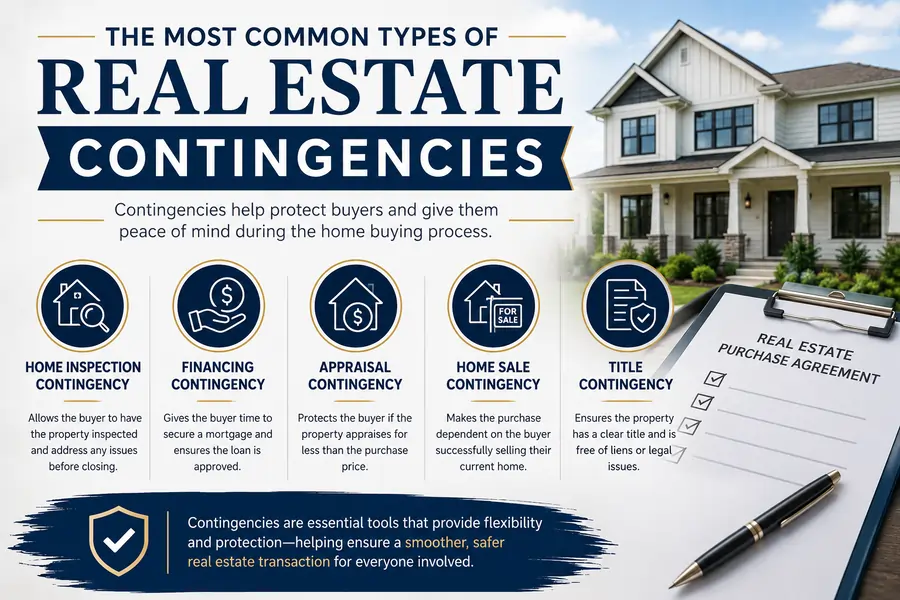
When a home is listed as contingent, the specific condition holding up the deal is usually one of a handful of standard clauses. Each one protects the buyer in a different way.
Home Inspection Contingency
The inspection contingency is one of the most common in any purchase agreement. It gives the buyer the right to hire a licensed home inspector to evaluate the property’s condition after an offer is accepted. If the inspection reveals significant problems, such as foundation damage, a failing roof, outdated electrical systems, or hidden water intrusion, the buyer can request repairs, ask for a price reduction, or walk away from the deal entirely.
In a 2023 Zillow survey, 67% of buyers reported their offer was contingent on the property passing a home inspection. This contingency is essentially standard practice in most U.S. real estate markets.
Financing Contingency
A financing contingency protects the buyer if they are unable to secure a mortgage for the purchase. Even when a buyer is pre-approved, final loan approval is not guaranteed. A lender may decline financing if the buyer’s financial situation changes, or if the home appraises below the loan amount. The financing contingency gives the buyer a defined window to obtain their loan without losing their earnest money deposit if the deal collapses for this reason.
Appraisal Contingency
Mortgage lenders require a professional appraisal to confirm that the home is worth at least the amount being borrowed. If the appraised value comes in lower than the agreed purchase price, the lender will not approve the full loan amount. An appraisal contingency allows the buyer to renegotiate the price, make up the difference in cash, or exit the deal. Without this contingency in place, a buyer could be obligated to proceed at a price that exceeds what the lender will finance.
Home Sale Contingency
A home sale contingency makes the purchase dependent on the buyer selling their current property first. Carrying two mortgages simultaneously is financially risky for most buyers, so this contingency protects them from that exposure. If the buyer’s existing home does not sell within the agreed timeframe, the deal can be canceled without penalty. Sellers sometimes view this type of contingency less favorably because it introduces uncertainty and delays, but it is common in markets where buyers are moving from one property directly into another.
Title Contingency
A title contingency allows the buyer to back out if a title search uncovers legal issues with the property’s ownership history. These can include undisclosed liens, unresolved judgments, boundary disputes, or errors in public records. A clean title is essential because the buyer needs to take full, unencumbered ownership of the property at closing. Title insurance typically protects buyers going forward, but this contingency ensures the buyer is aware of any title problems before committing.
Contingent vs. Pending: What Is the Difference?
Contingent and pending are often used interchangeably by buyers, but they signal very different stages of the sale process. Knowing the distinction helps you assess whether a listing still has any realistic chance of becoming available.
Contingent means the seller has accepted an offer, but one or more conditions have not yet been resolved. The home remains active to some degree because the deal could still fall through. Depending on the contract, the seller may or may not still be accepting backup offers.
Pending means all contingencies have been cleared. The deal is no longer conditional. Both parties are now moving toward the final closing steps, including title transfer, final mortgage approval, and scheduling the closing date. A pending home is effectively sold in all but the paperwork.
The simplest way to frame it: contingent is “we have a deal, but a few things still need to happen,” while pending is “the deal is done, we are just wrapping up.”
| Status | Offer Accepted? | Conditions Cleared? | Still Possible to Buy? |
|---|---|---|---|
| Active | No | N/A | Yes |
| Contingent | Yes | No | Possibly (backup offer) |
| Pending | Yes | Yes | Rarely |
| Closed/Sold | Yes | Yes | No |
Types of Contingent Listing Statuses on the MLS
When you see a home listed as contingent on the MLS, there may be a secondary designation that gives you more detail about the current situation.
Contingent No Show means the seller has accepted an offer and is no longer showing the property to other buyers. The seller is confident enough in the current deal that they have stopped seeking additional interest.
Contingent Continue to Show (CCS) means the seller accepted an offer but is still allowing the property to be viewed and is open to backup offers. This is the most favorable status for buyers who are interested in a contingent home, because it signals the seller has some uncertainty about whether the current deal will close.
Contingent with Kick-Out Clause means the seller has accepted a contingent offer but retains the right to continue marketing the home. If a better offer comes in, the seller can notify the original buyer, who then has a limited window to remove their contingency and proceed, or the original contract is canceled. This status is particularly common when the primary contingency is a home sale contingency.
Contingent Short Sale means the accepted offer is below what the seller owes on the mortgage. Short sales require lender approval in addition to buyer-seller agreement, which can significantly extend the timeline.
Can You Make an Offer on a Contingent House?
Yes, you can make an offer on a contingent house, but it functions as a backup offer rather than a primary one. The seller already has a signed agreement with another buyer, which means your offer sits in second position unless the original deal collapses.
Backup offers are not wasted effort. Deals fall through for many reasons: financing falls apart, inspection negotiations stall, a home sale contingency does not resolve in time, or a buyer simply gets cold feet. If the original contract is canceled, having a backup offer on file can put you at the front of the line without going back to square one.
Before submitting a backup offer on a contingent listing, your real estate agent can find out which type of contingency is in place and how far along the current deal is. An inspection contingency that wraps up in a week is very different from a home sale contingency that may drag on for months. That context helps you decide whether waiting makes sense.
What Contingent Means for Sellers
For sellers, a contingent status means the home is technically under contract, but the transaction is not guaranteed. Each contingency introduces a window during which the deal can fall apart, and sellers need to manage that uncertainty carefully.
Some sellers choose to continue accepting backup offers even after going contingent. This provides protection if the primary deal collapses, reducing the time the home sits off-market during a second round of negotiations. Sellers in competitive markets often negotiate tighter contingency timelines to limit how long they are bound to an uncertain deal.
For sellers dealing with a situation where a fast, predictable closing matters, such as a job relocation, an inherited property, or a home that needs significant repairs, waiting through multiple rounds of buyer contingencies can be stressful. Selling directly to a cash buyer eliminates contingencies entirely: no financing approval to wait on, no appraisal hurdles, and no inspection negotiations. The process moves on a timeline that works for the seller.
What Happens When a Contingency Is Not Met?
When a contingency is not satisfied within the agreed timeframe, the buyer typically has the right to cancel the contract and recover their earnest money deposit. The seller then re-lists the property, and the process starts again.
The outcome depends on the specific language in the purchase agreement. Some contracts give buyers the right to extend contingency deadlines by mutual agreement. Others include automatic cancellation provisions if conditions are not met by a specific date.
From the seller’s perspective, a failed contingency means lost time and the cost of re-entering the market. This is why sellers frequently push for shorter contingency windows, particularly in competitive markets where they could have accepted another offer.
How to Move Forward If the Home You Want Is Contingent
Finding out a home you love is already under contract is frustrating, but it does not have to be the end of the road. Here is how to approach the situation strategically.
Ask your agent to contact the listing agent. Find out what type of contingency is in place, how long the contingency period lasts, and whether the seller is accepting backup offers. This information shapes your next move.
Submit a strong backup offer if the seller is open to it. A backup offer that is already in place gives the seller a clear path forward if the original deal falls through. Make the offer as clean as possible: strong financing, minimal contingencies, and a flexible closing timeline.
Stay patient but keep looking. A contingent listing may or may not become available again. Putting all your attention on one contingent home while passing on other active listings is a risky strategy, especially in a market with limited inventory.
Get pre-approved before you act. A pre-approval letter signals to the seller that you are a serious and capable buyer. In situations where the original deal falls apart, sellers want to move quickly to the next qualified offer. Having your financing documentation ready in advance gives you a meaningful advantage.
Does Contingent Mean the Same as Under Contract?
Not exactly, though the terms are often used interchangeably by buyers and even some real estate professionals. Under contract is a broader term that simply means the seller has accepted an offer. Contingent is more specific: it means the accepted offer is subject to conditions that have not yet been resolved.
All contingent properties are under contract, but not all properties under contract are contingent. A property can be under contract with all conditions already cleared, which would put it in pending status rather than contingent.
What Does Contingent Mean for Sellers Who Want a Faster Close?
If you are a homeowner in Louisville trying to sell quickly, the contingency process in traditional real estate can feel like a long obstacle course. Buyers add inspection contingencies, financing contingencies, and sometimes home sale contingencies that push your closing date weeks or even months into the future. Even after accepting an offer, you may spend weeks waiting for contingencies to clear before the sale becomes certain.
One alternative is selling directly to a cash home buyer. Because cash buyers do not require mortgage financing, the financing contingency disappears entirely. Cash buyers also typically purchase homes in their current condition, eliminating the back-and-forth that inspection contingencies create. The result is a faster, more predictable closing that does not depend on a chain of conditions all going right at the same time.
For sellers dealing with inherited properties, foreclosure timelines, or homes that need significant repairs, removing contingencies from the equation can make a meaningful difference.
Frequently Asked Questions
What does contingent mean on a house listing?
Contingent on a house listing means the seller has accepted a buyer’s offer, but the sale is not yet complete. The transaction is conditional on certain requirements being fulfilled, such as a satisfactory home inspection, mortgage approval, or the sale of the buyer’s current home. If those conditions are not met, the deal can fall apart and the property becomes available again.
Can I still buy a house that is listed as contingent?
Yes. You can submit a backup offer on a contingent home. If the primary buyer fails to meet the contingency requirements within the agreed timeframe, the seller can move forward with your offer instead. Ask your real estate agent to find out whether the seller is accepting backup offers and what contingency type is currently in place.
What is the difference between contingent and pending?
Contingent means an offer has been accepted but conditions still need to be resolved. Pending means all conditions have been cleared and the sale is moving toward the final closing steps. A pending home is further along and far less likely to return to the market than a contingent one.
How long does a house stay contingent?
The contingency period depends on the terms written into the purchase agreement. Inspection contingencies typically last 7 to 14 days. Financing contingencies often run 21 to 30 days. Home sale contingencies can last 30 to 60 days or longer. Once all contingencies are satisfied, the listing moves to pending status.
Does contingent mean the house is no longer for sale?
Not exactly. A contingent home is under contract, but the sale is not finalized. If the buyer fails to meet the conditions within the stated timeframe, the home can return to active status. Many sellers accept backup offers during the contingency period for exactly this reason.
What is a kick-out clause in a contingent offer?
A kick-out clause allows the seller to continue marketing the home and accept new offers while the original contingent offer is still in place. If the seller receives a better offer, the original buyer is usually notified and given a short window (often 24 to 72 hours) to remove their contingency and proceed, or the contract is canceled.
The Bottom Line on What Contingent Means When Buying a House
When a house is listed as contingent, it means an offer has been accepted but the deal is not done yet. Conditions must be met before the sale can close. Those conditions exist to protect buyers, but they also create a window of uncertainty that can work in your favor if the original deal falls through.
Understanding the difference between contingent and pending, knowing which type of contingency is in place, and positioning yourself with a strong backup offer are all practical steps that can turn a “contingent” listing into your next home.
If you are a homeowner in Louisville looking to sell without the delays and uncertainty that contingencies create, Sisters Who Buy Houses offers a direct, no-contingency path to closing. No financing approvals, no inspection negotiations, and no waiting. Contact us today to get your no-obligation cash offer and find out how fast and simple selling your house can be.