
Need to sell a house with code violations in Louisville, KY but do not want to complete a long list of repairs before moving forward?
By submitting this form, you acknowledge that you have read our Privacy Policy and Terms & Conditions.
Yes. A house with code violations can still potentially be sold in Louisville, but the specific violations, notices, fines, liens, repair orders, and condition of the property need to be understood before closing. A code violation does not automatically mean the property has no value or that you must personally complete a full renovation before exploring a sale. The right path depends on what the violation involves and how far the enforcement process has progressed. Louisville homeowners generally have three options:
01
02
03
Sisters Who Buy Houses provides the third option for homeowners throughout Louisville and Jefferson County. If repairing the property would require substantial money, contractor coordination, permits, cleanup, or months of work, getting a direct offer first can give you another option to compare. Louisville Metro also provides an online system where property owners can look up property maintenance cases and violations associated with an address.
A code violation generally means that an existing property or condition does not meet an applicable requirement enforced by Louisville Metro. Louisville’s Property Maintenance Code establishes minimum standards related to existing structures, premises, equipment, sanitation, heating, protection from the elements, fire safety, and other basic property conditions. Violations can range from relatively straightforward maintenance issues to more serious conditions requiring substantial repairs. A particular house might therefore have issues involving:
Louisville Metro identifies common exterior violations such as high grass or weeds, garbage or debris, damaged structures, dangerous trees, and damaged or clogged roofs, gutters, and downspouts. Common interior violations include problems with furnaces, water heaters, leaks, damaged or mold-affected surfaces, and missing or nonworking smoke detectors.
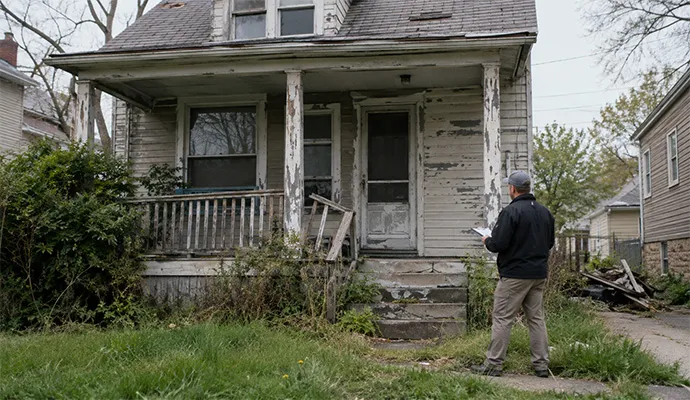
If you are researching how to sell a house with code violations, start by understanding what Louisville Metro has identified and then compare the cost of resolving those issues with your other selling options. For homeowners interested in a direct sale, the process can be straightforward.
01
Start with the actual property information rather than guessing what needs to be corrected. Review any violation notices, citations, inspection reports, repair orders, contractor estimates, or other documents you have received. Louisville Metro currently allows property owners and the public to search property maintenance cases through its online property violation system. When you contact Sisters Who Buy Houses, tell us about the violations you know about, the condition of the house, and your preferred selling timeline. If you want to understand our complete purchase process first, see how our home buying process works.
02
03
If the property fits our buying criteria, we can provide an offer for you to consider. Known property conditions and anticipated repair work are taken into account when evaluating the house. There is no obligation to accept the offer. Getting an actual number gives you something to compare with the potential expense of resolving the violations yourself and then listing the property traditionally.
04
Compare the direct offer with your other options. Correcting the violations yourself may make sense when the repair list is manageable and completing the work is likely to produce a substantially better financial result. Selling directly may be more practical when the property needs significant rehabilitation, enforcement issues are adding pressure, or you simply do not want to manage contractors and repairs before selling.
Homeowners searching for ways to sell a house with code violations for cash are often dealing with more than one repair problem. A single notice may identify multiple conditions, and the property may have other deferred maintenance that has not yet been addressed. A direct sale can provide another path before committing to a complete rehabilitation.
A direct buyer has to account for repair expenses, compliance work, renovation costs, holding expenses, resale costs, and investment risk when evaluating a property. That means an offer on a house with substantial violations and deferred maintenance may be lower than the potential retail price of the same home after all repairs are successfully completed. The more useful comparison is your estimated net proceeds, repair costs, time, enforcement status, carrying expenses, and certainty under each option.
Not necessarily before you explore a sale. You can contact Sisters Who Buy Houses and request an evaluation before completing every repair. However, selling a property does not mean you should ignore an active violation notice. The exact status of the case matters. Louisville Metro explains that when violations are found, Code Enforcement may issue a notice instructing the property owner to correct them. Continued noncompliance can result in additional enforcement actions depending on the circumstances. That is why it is useful to determine:
You can then determine how those issues will be handled within a potential sale. If you have received an official notice, contact information for the responsible inspector should appear on the notice, and Louisville Metro recommends contacting that inspector with questions about the violation.
Code violations can involve many different parts of a property. Some are primarily maintenance concerns, while others may involve safety or substantial deterioration. Examples may include:
These examples align with violations Louisville Metro currently identifies among its most frequently cited property maintenance issues. Your property may have different conditions, so the actual violation notice should guide your next steps.

Potentially, yes.
Code violations can slow down a traditional sale when the owner must first hire contractors, complete repairs, obtain permits where required, schedule work, clean the property, and prepare it for the market. After listing, a retail buyer may still request inspections, repairs, appraisal work, mortgage underwriting, and financing approval.
A direct cash purchase can remove several of those steps because you can explore an offer before completing the entire repair project. The actual closing timeline still depends on the individual property. Open liens, title defects, mortgages, probate matters, multiple owners, demolition orders, or other enforcement-related issues may require additional work before closing. The important distinction is that you do not necessarily need to finish every physical repair before beginning the conversation.
You can still explore an offer. Some properties have one relatively minor maintenance issue. Others may have years of deferred maintenance and multiple violations affecting the exterior, roof, plumbing, mechanical systems, interior condition, safety equipment, or accessory structures. A property with several violations can require a substantial repair budget. That does not automatically mean the house has no value.
Location, lot size, neighborhood, square footage, layout, remaining structure, and rehabilitation potential can still contribute to what the property is worth. The more serious the violations, the more important it becomes to understand the exact enforcement status and likely repair scope. If you already have notices, inspection documentation, contractor estimates, photographs, or related information, share those details when discussing the house.
A homeowner can sell a cluttered property without using a traditional listing agent.
If you decide to market the property yourself, you may need to determine its value, decide how much cleaning is necessary, photograph the house, find buyers willing to consider its current condition, coordinate access, negotiate the sale, and manage the transaction. Heavy clutter can make that process more difficult. Potential buyers may struggle to visualize the rooms, inspect important areas, or understand the underlying condition of the house. Some retail buyers may also expect the property to be cleared before closing.
Another option is selling directly to a professional buyer. When Sisters Who Buy Houses purchases a property, we are acting as the buyer rather than hiring you to market the home through the MLS. That can be useful for Louisville owners who want to avoid both a large cleanout project and the work involved in managing a traditional FSBO sale.
There is no single formula that determines what every cluttered property in Louisville is worth. The amount of personal property inside the house matters, but it is only one part of the evaluation. Factors that may affect an offer include:
For example, a Louisville property with an exterior maintenance notice and otherwise solid condition may be evaluated very differently from another house with structural deterioration, roof problems, plumbing issues, and years of deferred maintenance. Even houses in the same neighborhood can require very different repair budgets. That is why Sisters Who Buy Houses evaluates the individual property instead of applying a generic discount for code violations. Receiving an offer gives you a concrete number to compare with the cost and potential outcome of fixing the property yourself.
Having open property issues does not mean you should accept any offer simply to get rid of the house. The property may still have substantial underlying value. Its location, lot, size, layout, neighborhood demand, remaining condition, and redevelopment potential all matter. The right comparison also needs to account for what resolving the violations will cost. Suppose a Louisville house could potentially sell for more after renovation, but correcting the problems requires roofing work, plumbing repairs, debris removal, exterior maintenance, interior rehabilitation, contractor management, and several months of carrying expenses. The future retail price is not the same as your net proceeds. You still need to subtract the money, time, and selling expenses required to reach that condition.
A direct offer may make sense when avoiding those costs and uncertainties has meaningful value. On the other hand, if the violations are inexpensive to resolve and correcting them would substantially improve your financial outcome, completing the work before listing may be worth considering. Compare both paths before deciding.

Sisters Who Buy Houses is a Louisville home buying company operated by M & N Homes, LLC. We work with homeowners throughout Louisville and Jefferson County, including Old Louisville, Germantown, The Highlands, St. Matthews, Jeffersontown, Fern Creek, Middletown, Shively, Okolona, Lyndon, Valley Station, and surrounding communities. Louisville-specific knowledge matters because property conditions and repair decisions do not exist separately from the local housing market. Housing age, property type, renovation expectations, lot characteristics, neighborhood values, and rehabilitation costs can vary significantly across Louisville. Local code enforcement also operates under Louisville Metro’s Property Maintenance Code, which applies minimum maintenance standards to existing residential and nonresidential properties. That means evaluating a property with violations involves more than reading the notice. The property’s underlying market value, current physical condition, repair scope, and specific enforcement status all need to be considered together.
Code violations are specifically among the property conditions Sisters Who Buy Houses says it considers when purchasing Louisville homes. The company also identifies foundation problems, roof damage, fire or water damage, structural issues, tenant damage, and unfinished renovations among the types of conditions it works with.
That matters because properties with violations often have overlapping problems.
A roof violation may exist alongside interior water damage. Exterior deterioration may accompany years of deferred maintenance. A vacant property may have landscaping, structural, plumbing, or safety concerns at the same time.
Our process is designed to begin with the property in its current condition rather than requiring homeowners to complete a full rehabilitation before contacting us.
We also believe homeowners should compare their options.
If resolving the violations is affordable and likely to produce a significantly better net result, completing the repairs may make sense.
If the scope, cost, and uncertainty have become too much to manage, a direct sale gives you another option to evaluate.
01
02
03
04
Then compare that expected result with a direct offer for the property in its current condition. If resolving the issues is affordable and substantially improves your expected net proceeds, repairing first may make sense. If the cost, time, and enforcement pressure outweigh the likely financial benefit, selling in the property’s current condition may deserve serious consideration.