
You need to sell your house fast, and you need the money to move forward with your life. Whether you are relocating for a new job, going through a divorce, dealing with an inherited property, or simply tired of waiting, speed matters. The good news: selling quickly is absolutely possible — and with the right strategy, you do not have to sacrifice a fair price to do it.
The fastest way to sell your house fast is to accept a cash offer from a reputable buyer, which can close in as few as 7 to 14 days with no repairs, showings, or financing delays. If you prefer the open market, pricing at fair market value from day one, staging your home properly, and listing on the MLS with professional photography can attract serious offers within the first week.
This guide walks you through every proven strategy, from quick curb-appeal fixes to cash sale options, so you can choose the path that fits your timeline and your situation.
What Is the Fastest Way to Sell a House?
The fastest way to sell a house is to request a cash offer from a local cash buyer or iBuyer. Cash transactions eliminate the delays caused by mortgage underwriting, appraisals, and buyer financing contingencies. According to the National Association of Realtors (NAR), roughly 1 in 6 traditional purchase contracts experience delays or cancellations because of financing issues. With a cash offer, that risk drops to near zero.
If you want speed above all else, a cash sale is your answer. If you want speed AND a strong price, a combination of smart pricing, professional marketing, and MLS exposure on the open market can deliver offers within days — not months.
Understanding which path fits your situation is the first decision you need to make.
How Long Does It Take to Sell a House?
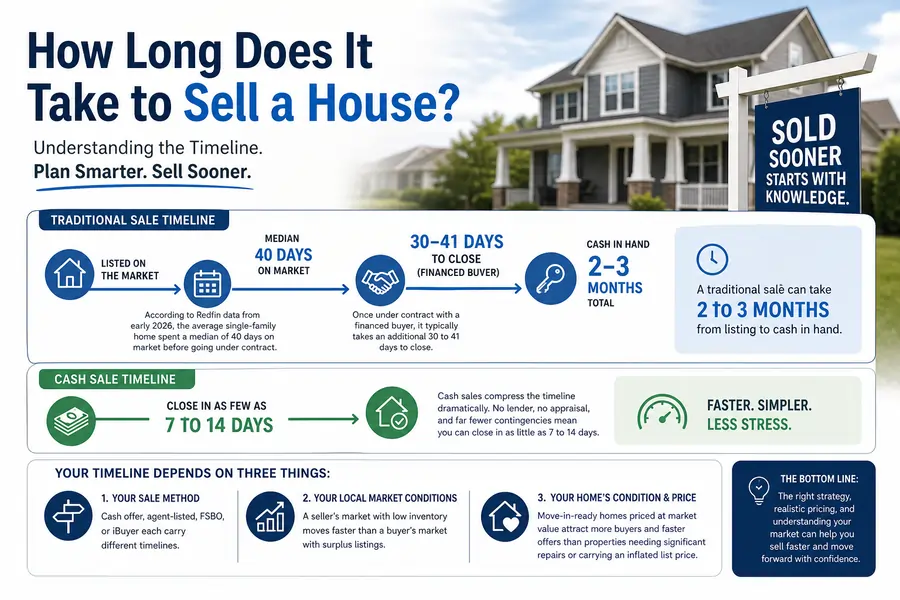
Selling a house fast starts with understanding a realistic timeline. According to Redfin data from early 2026, the average single-family home spent a median of 40 days on market before going under contract, with an additional 30 to 41 days needed to close once a financed buyer is under contract. That means a traditional sale can take two to three months from listing to cash in hand.
Cash sales compress that timeline dramatically. A direct cash sale can close in as few as 7 to 14 days because there is no lender involved, no appraisal requirement, and far fewer contingencies to navigate.
Your timeline depends on three things:
- Your sale method: Cash offer, agent-listed, FSBO, or iBuyer each carry different timelines.
- Your local market conditions: A seller’s market with low inventory moves faster than a buyer’s market with surplus listings.
- Your home’s condition and price: Move-in-ready homes priced at market value attract more buyers and faster offers than properties needing significant repairs or carrying an inflated list price.
If you are facing an urgent situation like foreclosure, divorce, or an inherited property you cannot afford to maintain, a cash sale is almost always the fastest and least stressful path forward. You can learn more about how the cash offer process works at Sisters Who Buy Houses to understand what a no-obligation offer looks like before you commit to anything.
Option 1: Sell to a Cash Buyer for Maximum Speed
Selling to a cash buyer is the single fastest way to get your house sold. Cash buyers — including local real estate investors and companies like Sisters Who Buy Houses — purchase properties directly from sellers without requiring you to list, stage, or show the home.
Here is what the cash buyer process typically looks like:
- You contact the buyer and share basic details about your property.
- The buyer evaluates the home, often without requiring a traditional inspection.
- You receive a no-obligation cash offer, usually within 24 to 48 hours.
- If you accept, you choose your closing date — sometimes as fast as 7 days.
- You close and receive your funds.
There are no agent commissions (typically 5% to 6% of the sale price), no repair costs, and no staging expenses. Cash buyers purchase homes as-is, which means you do not have to spend a dollar getting the property ready.
The trade-off is that cash offers are usually below full retail market value. Cash buyers factor in the cost of repairs, their profit margin, and the convenience they are providing you. However, when you subtract agent fees, closing costs, repair expenses, and the carrying costs of holding a property for two to three additional months, many sellers find the net difference is smaller than they expected.
If your home needs significant work or you are dealing with a complicated situation like selling a house during divorce or selling an inherited property, the simplicity of a cash sale often outweighs the price difference.
Request a free cash offer from Sisters Who Buy Houses — there is no obligation, and you can always compare it against a traditional listing before you decide.
Option 2: List on the Open Market With a Strategy Built for Speed
If getting close to market value matters to you and you have a few weeks to work with, listing your home on the open market with a speed-focused strategy can still produce a fast sale. The key is making the right moves before your listing goes live.
Price It Right From Day One
Pricing is the single most powerful variable in how quickly your house sells. Homes priced within 5% of their true market value sell significantly faster than overpriced listings, according to NAR research. Overpricing by even 10% can double or triple your days on market.
Many sellers make the mistake of pricing high to “leave room to negotiate.” In practice, this backfires. Buyers scroll past overpriced listings. Listings that sit too long begin to look suspicious, signaling to buyers that something must be wrong with the property. The longer a home sits, the more likely you are to receive lowball offers.
Work with an agent to run a Comparative Market Analysis (CMA) — a data-driven comparison of what similar homes in your neighborhood have actually sold for in the last three to six months. Price based on that data, not on what you wish the house were worth or what you need it to be worth to pay off your mortgage.
In competitive markets, pricing just slightly below market value can trigger multiple offers and actually push the final sale price higher than if you had started high.
Get on the MLS Immediately
The Multiple Listing Service (MLS) is the database that feeds property information to Zillow, Redfin, Realtor.com, and every buyer’s agent with active clients. Being on the MLS is non-negotiable if you want maximum exposure. A 2022 study by Bright MLS found that 63% of homes that started as private or pocket listings only sold after the sellers eventually listed on the MLS. Private listings that skip MLS exposure take longer to sell and often net less money.
Your listing agent will get your property on the MLS. If you are selling FSBO, you can still pay a flat-fee MLS service to get your home listed — but be aware that FSBO homes statistically sell for less and take longer without the marketing and negotiating expertise an experienced agent provides.
Use Professional Photography
Most buyers begin their home search on their phone. If your listing photos do not make them stop scrolling in the first two seconds, they move on. According to Redfin research, homes with professional photography sell 32% faster than those with amateur photos and tend to command higher prices.
Professional photographers understand lighting, angles, and framing. They know how to make a modest room look spacious and how to highlight a home’s best features. This is not the place to cut corners.
Stage Your Home (Even Minimally)
According to the NAR 2024 Profile of Home Staging, 81% of buyer’s agents reported that staging made it easier for buyers to visualize a property as their future home. Staged homes sell faster and for more money — and you do not have to hire a professional stager to get results.
The most impactful staging steps are also free:
- Declutter aggressively. Pack up personal items, family photos, and everything that makes the space feel like “your” home rather than a blank canvas for the next owner.
- Depersonalize. Buyers need to mentally move in. Your daughter’s trophy collection and the family vacation photos make that harder.
- Clean everything. A spotless home signals that the property has been well cared for. This builds buyer trust and reduces the likelihood of inspection-driven renegotiations later.
- Arrange furniture to maximize space. Remove extra pieces. Open floor plans photograph better and show better.
Boost Curb Appeal Before Photos Are Taken
Buyers form their first impression before they walk through the front door. Many decide whether to schedule a showing based on exterior photos alone. High-impact, low-cost curb appeal improvements include:
- Pressure washing the driveway and walkways
- Refreshing mulch in flower beds
- Planting seasonal flowers near the entrance
- Painting the front door a clean, welcoming color
- Updating house numbers and the mailbox
These improvements typically cost under $500 but can meaningfully reduce your days on market.
Should You Make Repairs Before Selling?
One of the most common questions sellers ask is whether they should invest in repairs before listing. The honest answer depends entirely on your timeline and budget.
Repairs can help you command a higher price and attract more conventional buyers, but they take time and money. Not every repair delivers a positive return on investment. For example, a full kitchen remodel rarely pays for itself in added sale price, while a fresh coat of neutral interior paint can meaningfully improve buyer perception at a very low cost.
If time is limited, focus only on repairs that buyers are likely to notice during a walkthrough or that a home inspector is likely to flag. A pre-listing inspection (typically $300 to $500) can give you a clear picture of your home’s condition before buyers bring their own inspector, preventing surprise renegotiations that delay closing.
If you are facing significant repairs and do not have the budget or the time, selling as-is may be your best option. An as-is sale attracts investors and cash buyers who are comfortable with the condition, and it eliminates lengthy back-and-forth negotiations over repair credits. For a clear breakdown of which repairs are worth making and which to skip, see what not to fix when selling a house.
How to Sell Your House Fast in Specific Situations
Not every fast home sale is driven by choice. Sometimes life forces your hand. Here is how to approach speed-selling in the most common urgent situations.
Selling a House Fast During Divorce
Divorce creates urgency from multiple directions: legal deadlines, shared financial obligations, and the emotional weight of staying tied to a property you both need to move on from. The priority is typically a clean, quick sale rather than maximizing every dollar.
A cash sale is often the best path in a divorce situation because it eliminates the coordination required between two parties who may not be communicating smoothly. No showings to schedule, no staging disagreements, no waiting on a buyer’s lender. You agree on a price, accept the offer, and close. Learn more about the process of selling a house during divorce if you are navigating this situation.
Selling an Inherited House Quickly
Inherited properties often come with complications: deferred maintenance, probate timelines, emotional attachments, and properties located far from where you actually live. Continuing to pay property taxes, utilities, and insurance on a property you did not plan to own drains resources fast.
A cash buyer will purchase an inherited property as-is, even if it has not been updated in decades, even if it needs significant repairs, and even if probate is still in process (in many cases). For a full breakdown of the options, read the guide on how to sell an inherited house.
Selling a House in Foreclosure
If you are behind on mortgage payments, you may have more time than you think — but not much. Selling before foreclosure is finalized allows you to pay off the mortgage, avoid a foreclosure on your credit record, and potentially walk away with some equity. A cash buyer can often close before the bank’s timeline forces the issue. See the full breakdown of whether you can sell a house in foreclosure and what your options are.
Timing: When Is the Best Time to Sell a House Fast?
Timing affects speed. Zillow data shows that homes listed in the last two weeks of May tend to sell for approximately 1.6% more than the national average. Spring and early summer are historically the fastest seasons for home sales because more buyers are actively searching and school-year schedules create deadline pressure to move.
That said, urgent sellers cannot always wait for May. If you need to sell now, a cash buyer operates year-round without any seasonal considerations. Cash offers do not dry up in winter or slow down in August. If you have flexibility, timing your open market listing for spring gives you the best chance of a fast sale at top price. If you do not have that flexibility, a cash offer is available whenever you need it.
How to Choose the Right Selling Strategy for Your Situation
Here is a practical framework for deciding which path to take:
Choose a cash sale if:
- You need to close in under 30 days
- Your home needs significant repairs you cannot afford
- You are navigating divorce, foreclosure, or an inherited property
- You want to skip showings, staging, and open houses entirely
- Certainty of closing matters more than maximizing sale price
Choose an agent-listed open market sale if:
- You have 6 to 10 weeks before you need to close
- Your home is in good or move-in-ready condition
- You want maximum exposure to qualified buyers
- Getting close to market value is a priority
The smart middle ground: Request a cash offer first, with no obligation to accept. Then compare it against an agent’s listing price estimate. Knowing both numbers gives you the data you need to make a confident decision. Visit Sisters Who Buy Houses to get a cash offer with no pressure and no fees.
Step-by-Step: How to Sell Your House Fast (Open Market Version)
If you are going the listing route, follow this sequence to compress your timeline as much as possible:
- Interview real estate agents. Choose someone who specifically understands speed-selling, not just price maximization. Ask about their average days on market.
- Get a Comparative Market Analysis (CMA). Price based on data from comparable recent sales within a half-mile radius.
- Order a pre-listing inspection. Identify and address any issues that could stall the transaction later.
- Declutter, depersonalize, and deep clean. Do this before the photographer arrives.
- Improve curb appeal. Exterior work and a fresh front door take one weekend and cost very little.
- Hire a professional photographer. Do not use your phone. This investment pays for itself in speed.
- List on the MLS. Ensure your agent lists on all major platforms simultaneously.
- Be flexible with showings. Every missed showing is a potential missed offer.
- Respond to all offers within 24 hours. Momentum is real in real estate. Slow responses kill deals.
- Evaluate offers by total net proceeds, not just price. A slightly lower cash offer with no contingencies can be worth more than a higher financed offer that might fall through.
Frequently Asked Questions About Selling Your House Fast
How fast can you sell a house for cash?
Selling your house for cash can be completed in as few as 7 days. Most cash sales close within 2 to 3 weeks. The timeline depends on how quickly both parties move through the contract, title search, and closing paperwork — there is no lender underwriting process to wait on.
What makes a house sell fast on the open market?
Three factors drive fast open-market sales: pricing at or just below fair market value from day one, professional photography that makes the listing stand out online, and MLS exposure that puts the home in front of every active buyer and buyer’s agent in your area. Staging and curb appeal accelerate the process further by generating more showings and stronger emotional responses from buyers who visit.
Is a cash offer always the best way to sell fast?
A cash offer is the fastest and most certain path to closing. It is not always the best option if getting top market value is your primary goal. The right answer depends on your timeline, your home’s condition, and how much the convenience of a no-repair, no-showing, no-contingency sale is worth to you. Many sellers request a cash offer first and then compare it to an agent’s listing estimate to make an informed decision.
Should I sell my house as-is or make repairs first?
If your home needs cosmetic updates only (paint, landscaping, minor fixtures), making those changes before listing generally returns more than they cost and helps attract more conventional buyers. If your home needs major structural or mechanical repairs that would take months and tens of thousands of dollars, selling as-is — typically to a cash buyer — saves you time, money, and stress. For a detailed breakdown of which fixes are worth it, see what not to fix when selling a house.
What are the signs my house will sell fast?
Homes that sell quickly tend to share several characteristics: they are priced accurately at market value, they are in good or move-in-ready condition, they have strong curb appeal, and they are in high-demand locations with low competing inventory. If you want to know how your home stacks up, see the guide on signs your house will sell fast for a detailed breakdown.
How much do cash buyers pay for houses?
Cash buyers typically pay below full retail market value because they are absorbing the risk of the property’s condition, the cost of any repairs, and the profit margin required to make the investment worthwhile. The actual discount varies widely — some offers are close to market value, others are significantly lower. The best way to know what a cash offer looks like for your specific property is to request one. Find out more about how much cash buyers pay for houses before you decide if this path makes sense for you.
Conclusion
Learning how to sell your house fast comes down to one core decision: how much speed do you need, and how much of your final sale price are you willing to trade for it? If you need to close in days and want to skip all the prep, showing, and waiting, a cash sale from a trusted buyer is your fastest and cleanest path. If you have a few weeks and a home in good condition, a well-priced MLS listing with professional photography and strong curb appeal can generate serious offers quickly without leaving money on the table.
Whatever path you choose, the worst thing you can do is wait and hope the market will come to you. A home that sits on the market loses buyer interest quickly and attracts lower offers the longer it sits. Act now, price it right, and use every tool available to you.
If you want to explore a cash offer with no obligation and no pressure, Sisters Who Buy Houses is ready to give you a fair offer and answer any questions you have about the process. You can also reach out directly through the contact page or read through the frequently asked questions to get a clearer picture of how a cash sale works.